> ## Documentation Index
> Fetch the complete documentation index at: https://translations.mintlify.site/llms.txt
> Use this file to discover all available pages before exploring further.
# MfaWebAuthnError
> Décrit toutes les propriétés et méthodes disponibles pour personnaliser l’écran `mfa-webauthn-error` dans Universal Login.
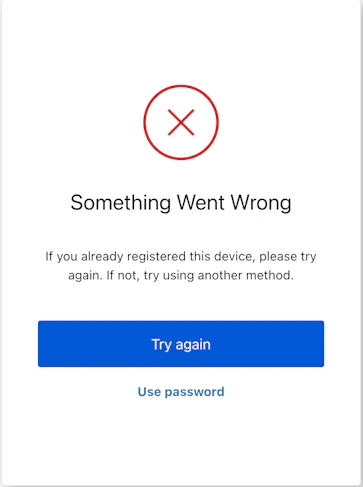
La classe MfaWebAuthnError implémente les fonctionnalités de l’écran `mfa-webauthn-error`. Cet écran s’affiche lorsqu’une erreur se produit lors d’une opération WebAuthn.
## Constructeurs
Créez une instance du gestionnaire de l’écran d’erreur MFA WebAuthn :
```typescript Example theme={null}
import MfaWebAuthnError from '@auth0/auth0-acul-js/mfa-webauthn-error';
const mfaWebAuthnError = new MfaWebAuthnError();
await mfaWebAuthnError.tryAgain();
```
## Propriétés
BrandingMembers}>
Fournit la configuration liée à l’image de marque, notamment le thème et les paramètres.
ClientMembers}>
Fournit la configuration liée à l’application, comme `id`, `name` et `logoUrl`, pour l’écran `mfa-webauthn-error`.
OrganizationMembers}>
Fournit des renseignements sur l’Organisation de l’utilisateur, comme `id` et `name`.
PromptMembers}>
Contient des données sur l’invite en cours dans le flux d’authentification.
ScreenMembersOnMfaWebAuthnError}>
Contient des détails propres à l’écran `mfa-webauthn-error`, y compris sa configuration et son contexte.
TenantMembers}>
Contient des données liées au locataire, comme `id` et les métadonnées associées.
TransactionMembers}>
Fournit des données propres à la transaction pour l’écran `mfa-webauthn-error`, comme les identifiants actifs et les états du flux.
UntrustedDataMembers}>
Gère les données non fiables transmises au SDK, comme la saisie de l’utilisateur lors du traitement des erreurs MFA WebAuthn.
UserMembers}>
Contient les détails de l’utilisateur actif, notamment `username`, `email` et `roles`.
## Méthodes
Cette méthode modifie la langue d’affichage de la page Universal Login.
```typescript Example theme={null}
import MfaWebAuthnError from '@auth0/auth0-acul-js/mfa-webauthn-error';
const mfaWebAuthnError = new MfaWebAuthnError();
mfaWebAuthnError.changeLanguage({
language: 'fr',
});
```
**Paramètres de la méthode**
[LanguageChangeOptions](/fr-CA/docs/libraries/acul/js-sdk/Screens/interfaces/LanguageChangeOptions).
Le code de langue souhaité (par exemple, `'en'`, `'fr'`, `'es'`).
Lorsqu’elle est définie sur `'session'`, la langue sélectionnée est conservée pendant toute la durée de la session.
Error[]}>
Cette méthode récupère le tableau des erreurs de transaction à partir du contexte, ou un tableau vide s’il n’y en a aucune.
Cette méthode permet à l’utilisateur de refuser l’opération WebAuthn en cours.
```typescript Example theme={null}
import MfaWebAuthnError from '@auth0/auth0-acul-js/mfa-webauthn-error';
const mfaWebAuthnError = new MfaWebAuthnError();
await mfaWebAuthnError.noThanks();
```
Cette méthode permet à l’utilisateur de réessayer l’opération WebAuthn précédente.
```typescript Example theme={null}
import MfaWebAuthnError from '@auth0/auth0-acul-js/mfa-webauthn-error';
const mfaWebAuthnError = new MfaWebAuthnError();
await mfaWebAuthnError.tryAgain();
```
Cette méthode permet à l’utilisateur d’essayer une autre méthode de MFA.
```typescript Example theme={null}
import MfaWebAuthnError from '@auth0/auth0-acul-js/mfa-webauthn-error';
const mfaWebAuthnError = new MfaWebAuthnError();
await mfaWebAuthnError.tryAnotherMethod();
```
Cette méthode permet à l’utilisateur de s’authentifier avec son mot de passe plutôt qu’avec WebAuthn.
```typescript Example theme={null}
import MfaWebAuthnError from '@auth0/auth0-acul-js/mfa-webauthn-error';
const mfaWebAuthnError = new MfaWebAuthnError();
await mfaWebAuthnError.usePassword();
```