> ## Documentation Index
> Fetch the complete documentation index at: https://translations.mintlify.site/llms.txt
> Use this file to discover all available pages before exploring further.
# PhoneIdentifierChallenge
> Décrit toutes les propriétés et méthodes disponibles pour personnaliser l’écran `phone-identifier-challenge` d’Universal Login.
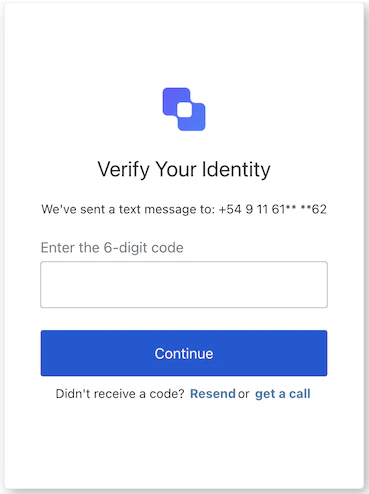
La classe PhoneIdentifierChallenge implémente la fonctionnalité de l’écran `phone-identifier-challenge`. Cet écran invite l’utilisateur à saisir un code de vérification envoyé à son numéro de téléphone afin de confirmer son identité.
## Constructeurs
Créez une instance du gestionnaire de l’écran PhoneIdentifierChallenge :
```typescript Example theme={null}
import PhoneIdentifierChallenge from '@auth0/auth0-acul-js/phone-identifier-challenge';
const phoneIdentifierChallengeManager = new PhoneIdentifierChallenge();
await phoneIdentifierChallengeManager.submitPhoneChallenge({
code: '123456',
});
```
## Propriétés
BrandingMembers}>
Fournit des configurations liées à l’image de marque, comme le thème et ses paramètres.
ClientMembers}>
Fournit des configurations liées à l’application, comme `id`, `name` et `logoUrl`, pour l’écran `phone-identifier-challenge`.
OrganizationMembers}>
Fournit des renseignements sur l’organisation de l’utilisateur, comme `id` et `name`.
PromptMembers}>
Contient des données sur l’invite actuelle dans le flux d’authentification.
ScreenMembersOnPhoneIdentifierChallenge}>
Contient des détails propres à l’écran `phone-identifier-challenge`, y compris sa configuration et son contexte.
TenantMembers}>
Contient des données liées au locataire, comme `id` et les métadonnées associées.
TransactionMembers}>
Fournit des données propres à la transaction pour l’écran `phone-identifier-challenge`, comme les identifiants actifs et les états du flux.
UntrustedDataMembers}>
Gère les données non fiables transmises au SDK, comme les entrées utilisateur pendant le flux de défi par téléphone.
UserMembers}>
Détails sur l’utilisateur actif, y compris `username`, `email` et `roles`.
## Méthodes
Cette méthode modifie la langue d’affichage de la page Universal Login.
```typescript Example theme={null}
import PhoneIdentifierChallenge from '@auth0/auth0-acul-js/phone-identifier-challenge';
const phoneIdentifierChallengeManager = new PhoneIdentifierChallenge();
phoneIdentifierChallengeManager.changeLanguage({
language: 'fr',
});
```
**Paramètres de la méthode**
[LanguageChangeOptions](/fr-CA/docs/libraries/acul/js-sdk/Screens/interfaces/LanguageChangeOptions).
Le code de langue de la langue souhaitée (par exemple, `'en'`, `'fr'`, `'es'`).
Lorsque cette valeur est définie sur `'session'`, la langue sélectionnée est conservée pendant toute la session.
Error[]}>
Cette méthode récupère le tableau des erreurs de transaction à partir du contexte, ou un tableau vide s’il n’y en a aucune.
Cette méthode renvoie le code de vérification au numéro de téléphone de l’utilisateur.
```typescript Example theme={null}
import PhoneIdentifierChallenge from '@auth0/auth0-acul-js/phone-identifier-challenge';
const phoneIdentifierChallengeManager = new PhoneIdentifierChallenge();
await phoneIdentifierChallengeManager.resendCode();
```
ResendControl}>
Cette méthode fournit une fonctionnalité de renvoi avec gestion du délai d’expiration. Elle renvoie un objet [`ResendControl`](/fr-CA/docs/libraries/acul/js-sdk/Screens/interfaces/ResendControl) avec une méthode `startResend()` qui déclenche le renvoi et impose une période d’attente avant que l’utilisateur puisse renvoyer le code à nouveau.
```typescript Example theme={null}
import PhoneIdentifierChallenge from '@auth0/auth0-acul-js/phone-identifier-challenge';
const phoneIdentifierChallengeManager = new PhoneIdentifierChallenge();
const { startResend } = phoneIdentifierChallengeManager.resendManager({
timeoutSeconds: 30,
});
await startResend();
```
**Paramètres de la méthode**
[StartResendOptions](/fr-CA/docs/libraries/acul/js-sdk/Screens/interfaces/StartResendOptions).
La durée de la période d’attente, en secondes, avant que l’utilisateur puisse renvoyer le code à nouveau.
OnStatusChangeCallback}>
Callback invoqué chaque fois que le statut du renvoi change; il renvoie le nombre de secondes restantes et indique si la fonctionnalité de renvoi est actuellement désactivée.
Callback invoqué lorsque la période d’attente prend fin et que le renvoi redevient disponible.
Cette méthode ramène l’utilisateur à l’écran précédent.
```typescript Example theme={null}
import PhoneIdentifierChallenge from '@auth0/auth0-acul-js/phone-identifier-challenge';
const phoneIdentifierChallengeManager = new PhoneIdentifierChallenge();
await phoneIdentifierChallengeManager.returnToPrevious();
```
Cette méthode soumet le code de vérification téléphonique pour terminer la vérification.
```typescript Example theme={null}
import PhoneIdentifierChallenge from '@auth0/auth0-acul-js/phone-identifier-challenge';
const phoneIdentifierChallengeManager = new PhoneIdentifierChallenge();
await phoneIdentifierChallengeManager.submitPhoneChallenge({
code: '123456',
});
```
**Paramètres de la méthode**
[PhoneChallengeOptions](/fr-CA/docs/libraries/acul/js-sdk/Screens/interfaces/PhoneChallengeOptions).
Le code de vérification envoyé au numéro de téléphone de l’utilisateur.
Le jeton de réponse CAPTCHA, si CAPTCHA est activé pour ce locataire.
Cette méthode fait passer la méthode d’envoi du code de vérification au message texte SMS.
```typescript Example theme={null}
import PhoneIdentifierChallenge from '@auth0/auth0-acul-js/phone-identifier-challenge';
const phoneIdentifierChallengeManager = new PhoneIdentifierChallenge();
await phoneIdentifierChallengeManager.switchToText();
```
Cette méthode fait passer la méthode d’envoi du code de vérification à un appel vocal.
```typescript Example theme={null}
import PhoneIdentifierChallenge from '@auth0/auth0-acul-js/phone-identifier-challenge';
const phoneIdentifierChallengeManager = new PhoneIdentifierChallenge();
await phoneIdentifierChallengeManager.switchToVoice();
```