Documentation Index
Fetch the complete documentation index at: https://translations.mintlify.app/llms.txt
Use this file to discover all available pages before exploring further.
이 노트북은 대화형 노트북입니다. 로컬에서 실행하거나 아래 링크를 사용해 보세요: # 필요한 의존성 설치
!pip install openai weave -q
python
import json
import os
from google.colab import userdata
from openai import OpenAI
import weave
python
# API Keys 가져오기
os.environ["OPENAI_API_KEY"] = userdata.get(
"OPENAI_API_KEY"
) # 왼쪽 메뉴에서 Colab 환경 시크릿으로 키를 설정하세요
os.environ["WANDB_API_KEY"] = userdata.get("WANDB_API_KEY")
# 프로젝트 이름 설정
# PROJECT 값을 프로젝트 이름으로 변경하세요
PROJECT = "vlm-handwritten-ner"
# Weave 프로젝트 초기화
weave.init(PROJECT)
1. Weave로 프롬프트 생성 및 반복 개선
# Weave로 프롬프트 객체 생성
prompt = """
Extract all readable text from this image. Format the extracted entities as a valid JSON.
Do not return any extra text, just the JSON. Do not include ```json```
Use the following format:
{"Patient Name": "James James","Date": "4/22/2025","Patient ID": "ZZZZZZZ123","Group Number": "3452542525"}
"""
system_prompt = weave.StringPrompt(prompt)
# Weave에 프롬프트 게시
weave.publish(system_prompt, name="NER-prompt")
better_prompt = """
You are a precision OCR assistant. Given an image of patient information, extract exactly these fields into a single JSON object—and nothing else:

- Patient Name
- Date (MM/DD/YYYY)
- Patient ID
- Group Number

Validation rules:
1. Date must match MM/DD/YY; if not, set Date to "".
2. Patient ID must be alphanumeric; if unreadable, set to "".
3. Always zero-pad months and days (e.g. "04/07/25").
4. Omit any markup, commentary, or code fences.
5. Return strictly valid JSON with only those four keys.

Do not return any extra text, just the JSON. Do not include ```json```
Example output:
{"Patient Name":"James James","Date":"04/22/25","Patient ID":"ZZZZZZZ123","Group Number":"3452542525"}
"""
# 프롬프트 편집
system_prompt = weave.StringPrompt(better_prompt)
# 편집된 프롬프트를 Weave에 게시
weave.publish(system_prompt, name="NER-prompt")
base64로 인코딩되어 있으므로, LLM이 별도의 전처리 없이 바로 사용할 수 있습니다.
# 다음 Weave 프로젝트에서 데이터셋을 가져옵니다
dataset = weave.ref(
    "weave://wandb-smle/vlm-handwritten-ner/object/NER-eval-dataset:G8MEkqWBtvIxPYAY23sXLvqp8JKZ37Cj0PgcG19dGjw"
).get()

# 데이터셋에서 특정 예시에 접근합니다
example_image = dataset.rows[3]["image_base64"]

# example_image를 표시합니다
from IPython.display import HTML, display

html = f'<img src="{example_image}" style="max-width: 100%; height: auto;">'
display(HTML(html))
- 데이터셋에서 PIL 이미지를 입력으로 받아 VLM에 전달할 수 있는
base64로 인코딩된 이미지 문자열을 반환하는 encode_image 함수
- 이미지와 시스템 프롬프트를 입력으로 받아, 시스템 프롬프트에 설명된 대로 해당 이미지에서 추출된 엔터티를 반환하는
extract_named_entities_from_image 함수
# GPT-4-Vision을 사용하는 추적 가능한 함수
def extract_named_entities_from_image(image_base64) -> dict:
    # LLM 클라이언트 초기화
    client = OpenAI()

    # 지시 프롬프트 설정
    # Weave에 저장된 프롬프트를 사용하려면 다음을 참고하세요: weave.ref("weave://wandb-smle/vlm-handwritten-ner/object/NER-prompt:FmCv4xS3RFU21wmNHsIYUFal3cxjtAkegz2ylM25iB8").get().content.strip()
    prompt = better_prompt

    response = client.responses.create(
        model="gpt-4.1",
        input=[
            {
                "role": "user",
                "content": [
                    {"type": "input_text", "text": prompt},
                    {
                        "type": "input_image",
                        "image_url": image_base64,
                    },
                ],
            }
        ],
    )

    return response.output_text
named_entity_recognation이라는 함수를 만들어 다음을 수행하세요:
- 이미지 데이터를 NER 파이프라인에 전달하고
- 결과를 올바르게 포맷된 JSON으로 반환합니다
@weave.op() decorator 데코레이터를 사용하여 W&B UI에서 함수 실행을 자동으로 추적하고 기록합니다.
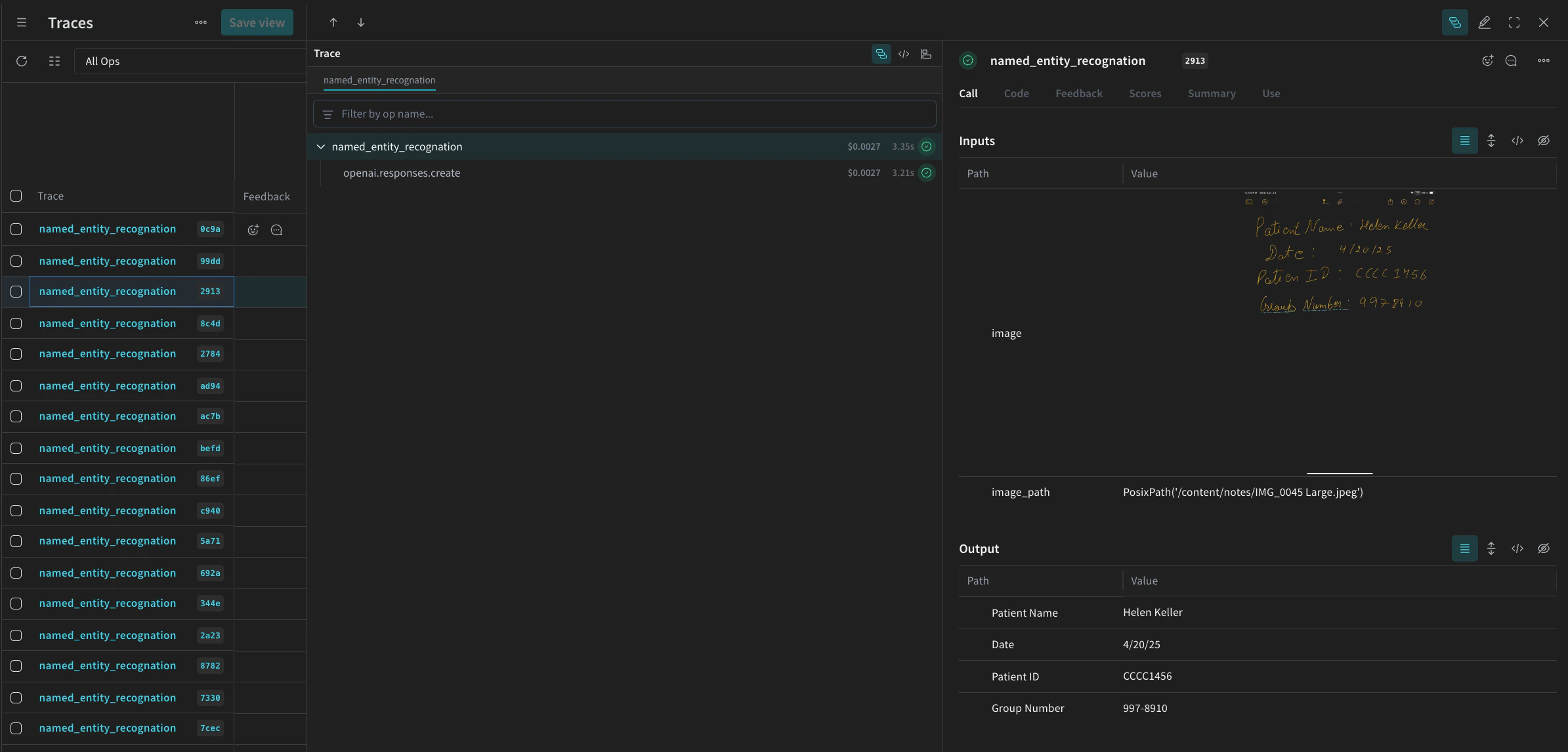
named_entity_recognation 함수를 실행할 때마다 전체 트레이스 결과를 Weave UI에서 확인할 수 있습니다. 트레이스를 보려면 Weave 프로젝트의 Traces 탭으로 이동하세요.
# 평가를 위한 NER 함수
@weave.op()
def named_entity_recognation(image_base64, id):
    result = {}
    try:
        # 1) vision op 호출, JSON 문자열 반환
        output_text = extract_named_entities_from_image(image_base64)

        # 2) JSON을 정확히 한 번 파싱
        result = json.loads(output_text)

        print(f"Processed: {str(id)}")
    except Exception as e:
        print(f"Failed to process {str(id)}: {e}")
    return result
processing_results.json에 저장합니다. 결과는 Weave UI에서도 확인할 수 있습니다.
# 출력 결과
results = []

# 데이터셋의 모든 이미지를 순회
for row in dataset.rows:
    result = named_entity_recognation(row["image_base64"], str(row["id"]))
    result["image_id"] = str(row["id"])
    results.append(result)

# 모든 결과를 JSON 파일로 저장
output_file = "processing_results.json"
with open(output_file, "w") as f:
    json.dump(results, f, indent=2)

print(f"Results saved to: {output_file}")
- Programatic Scorer
- LLM-as-a-judge Scorer
프로그램 기반 스코어러인 check_for_missing_fields_programatically는 모델 출력(named_entity_recognition 함수의 출력)을 입력으로 받아, 결과에서 어떤 keys가 누락되었거나 비어 있는지를 식별합니다.
이 검사는 모델이 어떤 필드도 추출하지 못한 샘플을 식별하는 데 매우 유용합니다.
# 스코어러의 실행을 추적하기 위해 weave.op()를 추가합니다
@weave.op()
def check_for_missing_fields_programatically(model_output):
    # 모든 항목에 필요한 키
    required_fields = {"Patient Name", "Date", "Patient ID", "Group Number"}

    for key in required_fields:
        if (
            key not in model_output
            or model_output[key] is None
            or str(model_output[key]).strip() == ""
        ):
            return False  # 이 항목에 누락되거나 비어 있는 필드가 있습니다

    return True  # 모든 필수 필드가 존재하며 비어 있지 않습니다
check_for_missing_fields_with_llm은 LLM(구체적으로 OpenAI의 gpt-4o)을 사용해 점수를 산출합니다. eval_prompt의 내용에 따라 check_for_missing_fields_with_llm은 Boolean 값을 출력합니다. 모든 필드가 이미지 정보와 일치하고 형식이 올바르면 Scorer는 true를 반환합니다. 어떤 필드든 누락되어 있거나 비어 있거나 잘못되었거나 불일치가 있으면 결과는 false가 되며, Scorer는 문제를 설명하는 메시지도 함께 반환합니다.
# LLM-as-a-judge의 시스템 프롬프트

eval_prompt = """
You are an OCR validation system. Your role is to assess whether the structured text extracted from an image accurately reflects the information in that image.
Only validate the structured text and use the image as your source of truth.

Expected input text format:
{"Patient Name": "First Last", "Date": "04/23/25", "Patient ID": "131313JJH", "Group Number": "35453453"}

Evaluation criteria:
- All four fields must be present.
- No field should be empty or contain placeholder/malformed values.
- The "Date" should be in MM/DD/YY format (e.g., "04/07/25") (zero padding the date is allowed)

Scoring:
- Return: {"Correct": true, "Reason": ""} if **all fields** match the information in the image and formatting is correct.
- Return: {"Correct": false, "Reason": "EXPLANATION"} if **any** field is missing, empty, incorrect, or mismatched.

Output requirements:
- Respond with a valid JSON object only.
- "Correct" must be a JSON boolean: true or false (not a string or number).
- "Reason" must be a short, specific string indicating all the problem — e.g., "Patient Name mismatch", "Date not zero-padded", or "Missing Group Number".
- Do not return any additional explanation or formatting.

Your response must be exactly one of the following:
{"Correct": true, "Reason": null}
OR
{"Correct": false, "Reason": "EXPLANATION_HERE"}
"""

# Scorer 실행을 추적하기 위해 weave.op() 추가
@weave.op()
def check_for_missing_fields_with_llm(model_output, image_base64):
    client = OpenAI()
    response = client.chat.completions.create(
        model="gpt-4o",
        messages=[
            {"role": "developer", "content": [{"text": eval_prompt, "type": "text"}]},
            {
                "role": "user",
                "content": [
                    {
                        "type": "image_url",
                        "image_url": {
                            "url": image_base64,
                        },
                    },
                    {"type": "text", "text": str(model_output)},
                ],
            },
        ],
        response_format={"type": "json_object"},
    )
    response = json.loads(response.choices[0].message.content)
    return response
dataset 전체를 자동으로 순회하면서 결과를 Weave UI에 모아서 기록하는 평가 호출을 정의합니다.
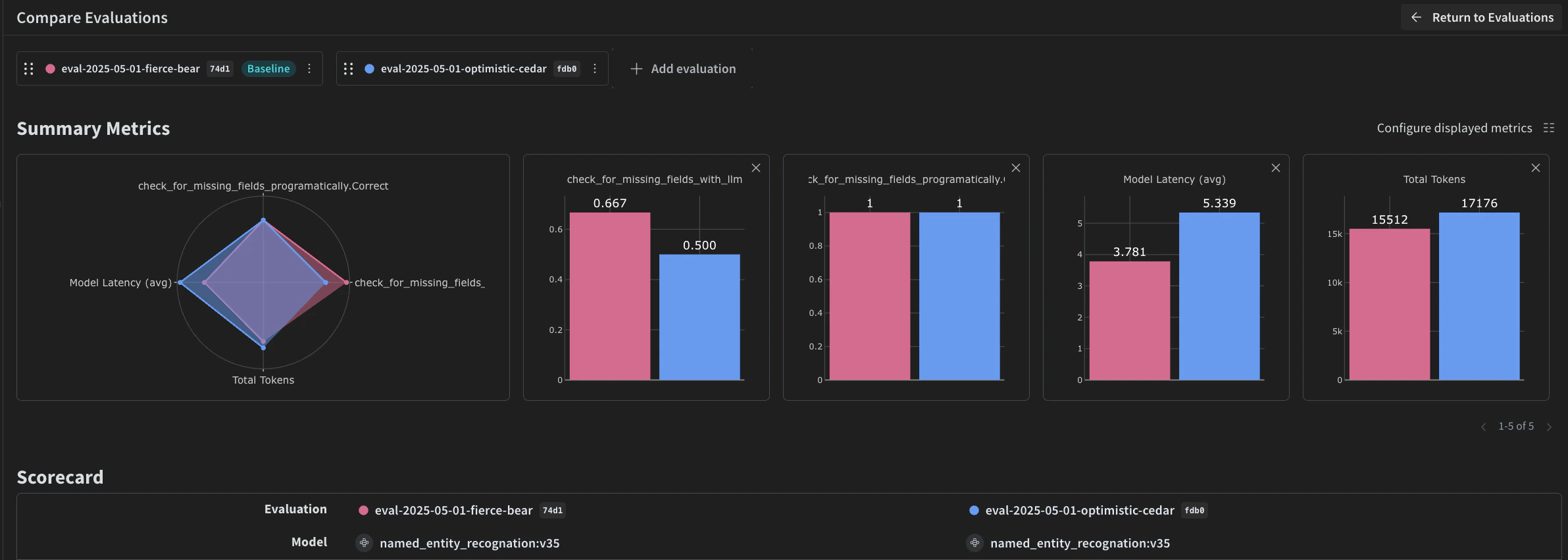
다음 코드는 평가를 실행하고, NER 파이프라인의 모든 출력에 두 개의 Scorer를 적용합니다. 결과는 Weave UI의 Evals 탭에서 확인할 수 있습니다.
evaluation = weave.Evaluation(
    dataset=dataset,
    scorers=[
        check_for_missing_fields_with_llm,
        check_for_missing_fields_programatically,
    ],
    name="Evaluate_4.1_NER",
)

print(await evaluation.evaluate(named_entity_recognation))


 플랫폼
플랫폼 W&B Models
 W&B Weave
 W&B Inference
 W&B 교육
 릴리스 노트